Writer’s Block…ah, that dreaded word. The arch nemesis of every writer, whether your specialty is prose, poetry, song writing, or some other medium. If Writer’s Block were a person, it would be one we cross the street to avoid. It’s the antagonist to our muse. The darkness we pretend doesn’t exist.
For most of us, Writer’s Block is an obstacle we try to not think about, but it comes like snowfall anyway. It can come gradually or in one blindingly white night, but it leaves us frostbitten and unsure of our path forward.
But according to Jacqueline Woodson, an award-winning author for children and adolescents, writer’s block doesn’t exist; it’s “an excuse…If you want to write, you’re going to write…Is it writer’s block or are you not a writer?” (You can find the whole interview on the She Writes Podcast, Write-minded).
When you hear her speak and then look at the breadth of work she has produced, you’d be hard-pressed to argue with her. She writes like she’s running out of time, like it’s the only way to survive. Though there’s not just one type of writer, I think most of us can agree we feel like writing is the way we breathe. That’s why Writer’s Block feels so terrible. How could we forget how to do something that feels so innate? So we shame spiral rather than look at the issue clearly.
What we call Writer’s Block with a capital “WB” is actually the fear that we’re not writers; that what we have to say doesn’t matter or doesn’t need to be said. When we write, we build worlds, emboldening desires too secret to say aloud, form relationships that literally stop time…but then we stop ourselves before we ever begin. In case it’s terrible. In case someone somewhere at some point says, “This was a waste of time.”
But what makes you a writer isn’t whether you have a publishing history or whether you’ve got followers on social media who fawn over your work. You’re a writer if you write. And the more you write, the more a writer you will be. The more your loud-mouthed, vindictive, annoying-voice-that-sounds-obnoxiously-accurate self-critic will quiet and you’ll be able to hear yourself think. Because the words are there. You know what you have to say; you are the only person that can say it. And there might be people who hate it. But there are also people who need your story to validate their experience. Who are waiting to get lost in your words.
When that icy dread steals itself into your body, here are some reminders to help warm you up:
- The only way to get to the final draft is to write the first.
- You can’t edit a blank page.
- Don’t compare yourself to a finished product. When you look at published work like a novel or anthology of poems, or when you hear a song on the radio, you are seeing the final product, not the hours of work that went into creating it.
- Say aloud, “I am a writer. My story deserves to be told.”
- Join a Writing Group (see previous blog post, “A Writing Tip for When you Feel Like a Literary Potato”). Writing Groups will help you feel not so alone and give you the resources to continue.
- Read books on writing such as The Book on Writing by Paula LaRocque (see previous blog post, “A Writing Tip from America’s Coach”). Some of my other favorites include:
- The Art of Subtext: Beyond Plot by Charles Baxter
- The Writing Life by Annie Dillard
- Bird by Bird by Anne Lamott.
- Read. Just read. Reading good writing will excite you to do the same. Reading bad writing will be the catalyst you need to go write something better. Reading comics and graphic novels and newspapers and magazines and books from all different genres by authors from all different backgrounds will teach you craft: how sentences are strung together, what characters pull you from your seat and into the story, how thoughts are expressed, how subtext is used, the way chapters and paragraphs are arranged, which stories leave their mark on your life.
- Take a hint from NY Book Editors, and synthesize your issue down to the three core aspects of a novel:
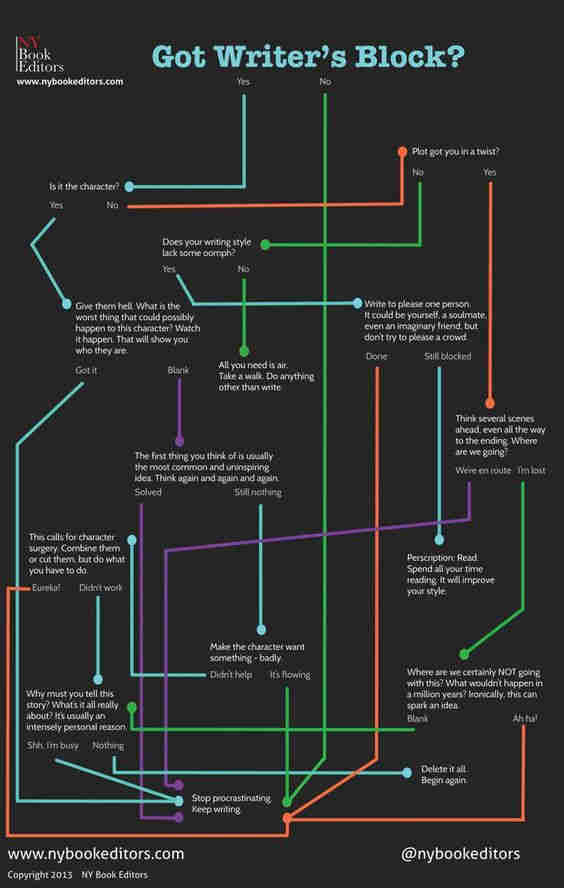
If it’s character, here’s a tip: Introduce your main character in the first 300 words, all the important characters in the first chapter, and then produce the challenge for the main character in the first 50 pages.
If it’s plot, here’s a tip: create arcs with 3 acts.”Story should have three acts: the challenge, the action, and the consequences,” as should every scene.
If it’s idea, here’s a tip: ask yourself,”Ultimately, what do I want from my reader? When my reader finishes, what question do I want answered?”
 Elegance Press
the Perfect thing I wanted to read today. Thanks for sharing
LikeLiked by 1 person
Thank you for reading! I’m so glad it spoke to you. Was there one tip in particular that helped or was it just knowing we all go through it?
LikeLike