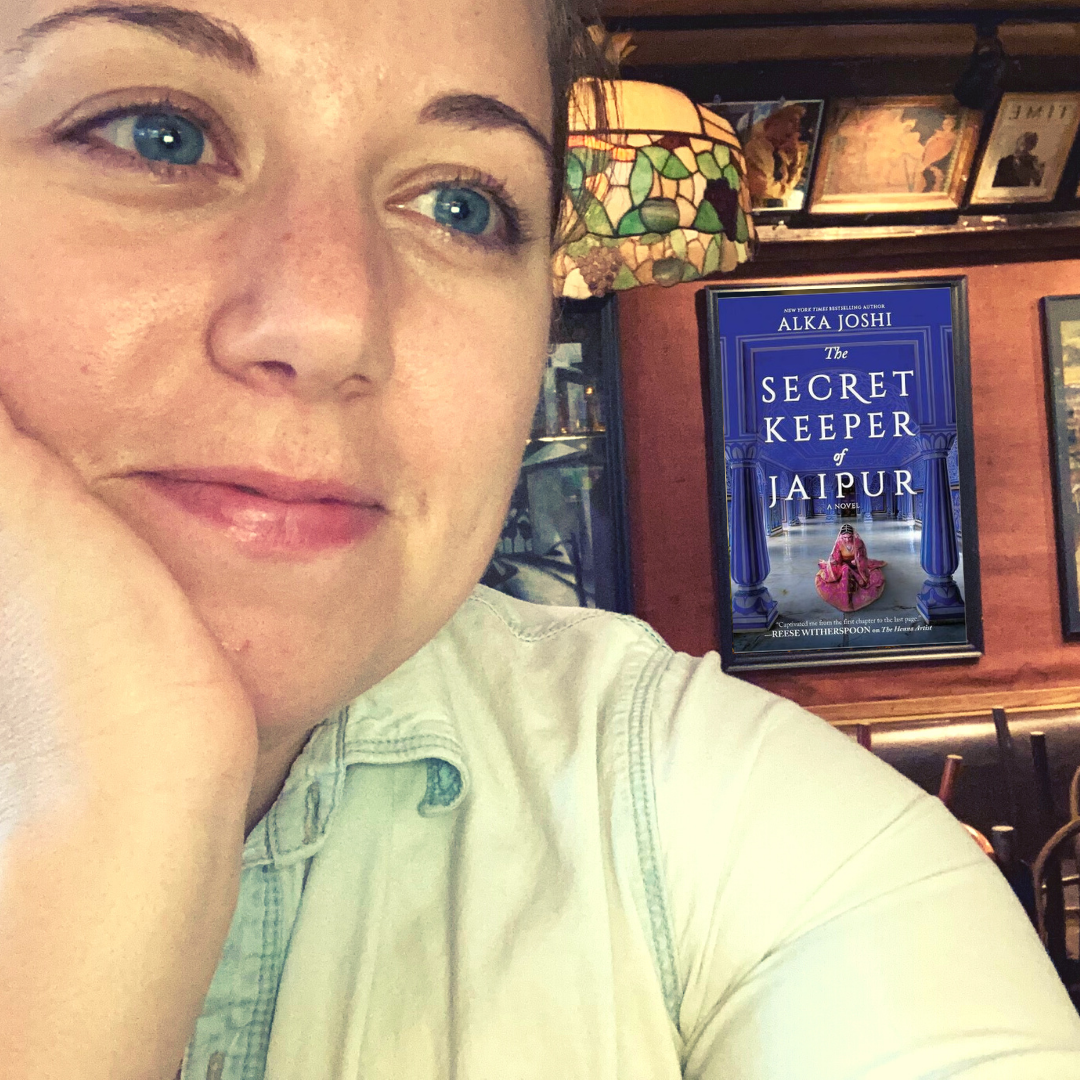

Category: Apple Blossom-a story that seduces you
Genre: Fiction, Historical Fiction
You know me, I’m a “find my way into a random, used bookstore and accidentally spend $300 on books” kind of woman. I’m a “just one more chapter at midnight” kind of woman. My best spent day is on the couch reading a book cover to cover. I don’t have the space on my shelf to preorder books and it’s a rare author who can push aside all the others on my reading list and demand to be seen. But Alka Joshi is now one of them.
I read her first novel, The Henna Artist, back in February as a part of Crawford’s Mystery and More! Book Club. That book was as delicious as the samosas that Lakshmi cooks for Radha (and that Joshi cooks for us on YouTube!). So you bet I couldn’t wait for the sequel and was oh-so-glad when I learned that it would ultimately be a trilogy.
Can I just take a second to pause and thank our lucky stars that we have a writer like Joshi? First of all, she gives us characters that we love like family. But she doesn’t stop there! After the story is over, she gives us glimpses into the character’s lives that lets us know they’re going to be okay. And then she gives us more stories with our favorite side characters so we can continue the daydream. The Secret Keeper of Jaipur follows Malik, now a young adult in his young twenties, who has left his love and his Auntie Boss back in Shimla and returned to Jaipur to study construction. Joshi puts us back in the world we remember with characters like Samir and the elder maharani, but uses her story-telling prowess to intensify the drama with everything from a collapsing building to gold-smuggling sheep.
Then, she gives us female protagonists and antagonists. Real women with fully fleshed-out backgrounds; women that we laugh with or cringe at or are saddened for but all women we know and understand. In The Henna Artist, we had a whole cast of female characters led by Radha and Parvati; in The Secret Keeper of Jaipur, we have Nimmi and Sheela. The stories are singular and their trauma is unique, but Joshi’s success remains the same: she gives us a stage to see strong, powerful women creating friendships and alliances and changing the world.
Last but not least, and here I’ll speak for myself, she educated me; she took away the mirage and let me coexist with people who don’t look, talk, dress, eat, or live like me and had me value what they have to offer. We need these stories and I’m so happy Joshi joins the wide array of authors telling stories with women and people of color front and center. I am all about it and can’t wait for her final installment that chronicles the story of Radha coming out in 2022! Keep reading to see my special interview with best-selling author, Alka Joshi!
1. Did you always want to be a writer? No! I wanted to be an artist, but everyone always directed me toward writing. For example, when I was looking for my first job in a multinational advertising agency, I told them I wanted to be an Art Director. They looked at my work and said, “Don’t you want to be a writer? Your portfolio clearly shows you can write.” So I began writing ads. Then I wrote marketing copy. I wrote for websites. I was 51 before I started venturing into fiction.
Three important things had to happen in order for me to write The Henna Artist:
1) the 2008 mortgage crisis; 2) an MFA program only three miles from my house; 3) a condo my brother bought in our old hometown of Jaipur. The mortgage crisis meant that my business would slow down and I could do something else for two years while waiting for the recession to abate. In 2009, I enrolled in the MFA program in Creative Writing. At the same time, my mom asked me to chaperone her to the Jaipur condo. She said, “When you’re done with your semester, come back and get me.” We repeated that trip several times during my MFA program, which gave me a phenomenal one-on-one experience with my mom that I hadn’t had since I left home at 18 for Stanford. Mom and I would go to the Jaipur fruit market, and she would show me all the fruits she loved and couldn’t get in the states. We went to her old college and she told me how she’d been called back home by her father when she was in the middle of her studies to get married. In four short years, she had three children. My mother did everything that her upbringing expected of her, but she raised me to be self-sufficient, to follow my own path, make all my own decisions. I began wondering how I could repay her for that incredible gift. Well, I could create a fictional character who got to live the life that my mom never got to live. That’s how Lakshmi was born.
2. Was there any resistance by your father to the way your mom raised you? Not at all. My dad was busy working; he was a very hard worker. He stayed out of the way Mom was raising us because he saw that as my mother’s job. There were times as we were growing up when my brothers and I were doing our homework at the dining table, he would tell me to go help my mother in the kitchen. He never told my brothers to do that. So, I would go into the kitchen, but my mom would say, “You go back to your homework and do well at school and go to a great university.” My dad eventually got used to the fact that I was going to do what I wanted to do, and he supported me. To this day, he delights in my successes and is immensely proud of my new career as an author.
3. The sense of self-worth and agency your mom instilled in you shines through all of the characters in your novel. Can you speak more about the voice you lend to the novel? When I first entered the working world, I got into advertising and I kept hitting that glass ceiling. I looked around at all the guys around me who were making more money than me, going to lunch with the creative director and getting all the juicy projects. When I asked for more recognition or compensation, I was told I was too ambitious, too outspoken, a troublemaker. One day, I realized that the corporate system was not built for me, for women; the way to solve the problem was to start my own agency and set my own rules. And that’s what I did, hiring an all-female team and becoming successful beyond my wildest dreams. We as women don’t have to accept the conscripted idea of how we’re supposed to be. We can set our own agendas and determine our own ways of being. We are whole in and of ourselves and we deserve to make all the choices that determine our destiny. That’s what we need to understand and teach the next generation.
4. And we see that in Radha. I love that none of your characters are “good” or “bad.” They are all human, with our varied strengths and flaws. Characters need to be imperfect because people are imperfect—they have strengths and they have weaknesses. It’s important for readers to empathize with the characters, and imperfection helps them do that. Every character must also have a goal or intention—some tunnel they’re going through to get to the other side. Readers want to be able to connect with that intention.
5. Who was the hardest character to write? Hari. I didn’t like him to begin with. I wanted to send him away to war and have him die! But ultimately, I needed to find Hari’s humanity. And when I thought about it, I realized that he was 17 to Lakshmi’s 15 when they married. He was immature. He was selfish. He was brought up in a culture that held men in higher esteem than women. And he felt the pressure to procreate—a pressure that exists today for young South Asian couples. When Lakshmi failed to get pregnant, the gossip-eaters would have started asking, “Why aren’t you man enough to make a baby? Why isn’t Lakshmi being a good wife and providing children?” Then, when Hari discovered that Lakshmi was deliberately keeping herself childless, he lost it and got very abusive. That’s when Lakshmi deserted him. At that point, I think his mother would have folded him into her herbal practice to keep him from wallowing in grief. And through that healing work, he would have developed empathy for the women she serves. That’s when his journey took a turn, and he grew as a character.
6. You mentioned that you have a responsibility as a writer. Can you speak to that?I feel a responsibility to correct misperceptions about India, about South Asian people, and challenge stereotypes about 1950s India. For example, Western media has always played up conflicts between Hindus and Muslims. I wanted to show that harmony is possible and often present in Hindu-Muslim relationships. That’s why Malik, who is Muslim and Lakshmi, who is Hindu have a strong, symbiotic relationship. He is the yin to her yang and vice versa. Another stereotype I wanted to challenge is the Western notion of India as “third world” or “underdeveloped,” an illiterate, dirty place. I wanted readers to know that there is ample beauty and richness in the culture—like the centuries-old craft of henna or jewelry making or handloomed textiles. Of course, I wove societal realities like classism, colorism, and casteism into The Henna Artist, but I focused on what was working rather than what wasn’t. As an author, I want to provide hope and a means of moving forward in life.
7. What are some writing tips you’ve learned?
- Stay. With. It. It takes as long as it takes. Don’t rush it. You’re not going to write a couple drafts and then have it published overnight. It took me 10 years and 30 drafts to get The Henna Artist into readers’ hands.
- Never delete your work! It may come in handy in a later draft or new story. During revisions of The Henna Artist, I had to take out a lot of backstory on Malik and Radha as well as epilogues that informed their future stories. But that’s why the sequels are coming out so quickly. I already had all this material to draw from!
- It is so valuable and necessary is to talk to our mothers, fathers, aunts, and uncles about their lives growing up. What did they eat? What kind of games did they play? Who were their film idols growing up? These are different kinds of connections than we normally make with our relatives. While spending time with my mom in Jaipur, I learned about her life as a girl—a life I knew nothing about. I saw her as a person wholly separate from motherhood. We need more of that kind of learning if we are to understand the people who came before us and if we are to accurately record their lives.
8. How can readers best support you?
- Write a short review on Amazon or your own Facebook page (and tag me!)
- Like my author page on Facebook
- Recommend me to your book club, local bookstore, or library for a virtual event (I love doing these!)
- Keep an eye out for the sequels, including The Henna Artist episodic series from Miramax TV as well as a graphic novel, and a set of cartoons on my geriatric dachshunds.
 Elegance Press